
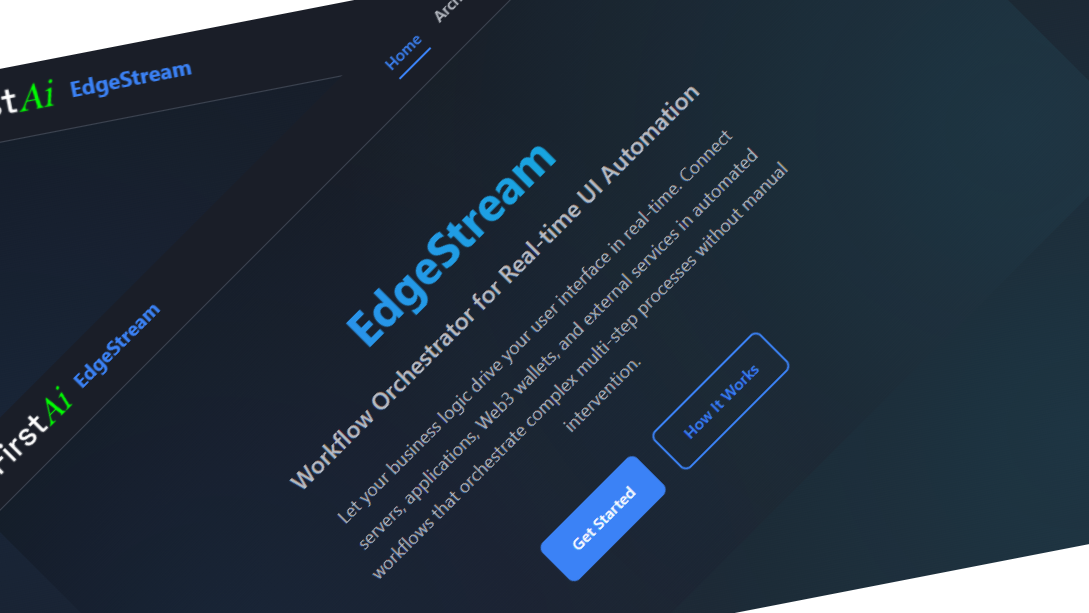
Rethinking the Browser: EdgeStream as a Real-Time Chat and Business Activity Engine

Modern Web Applications Need a New Browser Model
Modern web applications still treat the browser as a passive rendering layer.
The server executes business logic, APIs connect systems, and the browser simply
displays results and collects user input.
But this model limits what applications can do in real time.
EdgeStream from BizFirstAI introduces a new architectural approach where the browser
becomes an active workflow engine. Instead of just rendering UI, the browser participates
in intelligent workflows by interpreting structured messages, coordinating actions,
and interacting continuously with backend systems.
This transforms web applications from static request–response systems into dynamic, real-time orchestration platforms.
The Problem with Traditional Browser-Based Applications
In conventional web architecture, responsibilities are separated into fixed roles:
- The server handles business logic
- The browser renders user interfaces
- APIs connect systems through request–response cycles
While effective, this model introduces delays, complexity, and rigid workflows.
Every UI change requires a server round trip. Every workflow state must be explicitly managed.
The browser does not understand workflow intent. It only reacts.
This limits real-time interactivity and intelligent orchestration.
EdgeStream: Transforming the Browser into a Workflow Engine
EdgeStream changes this model by enabling continuous, structured communication
between the server and the browser.
Instead of sending simple responses, the server streams structured workflow messages containing context and intent.
The browser runs a lightweight workflow engine that interprets these messages
and responds intelligently.
This allows the browser to:
- Dynamically guide users through workflows
- Update the UI instantly based on workflow state
- Collect structured user input
- Resume workflows automatically
- React without page refreshes
The browser becomes an active participant in business processes.
Pipeline-Based Architecture for Intelligent Processing
At the core of EdgeStream is a flexible pipeline architecture.
Each message flows through composable processing stages that can:
- Validate incoming messages
- Enrich data with contextual information
- Transform workflow instructions
- Route logic dynamically
- Trigger UI behavior
This pipeline can also integrate Small Language Models (SLMs), allowing the system
to interpret intent and adapt workflows intelligently.
This creates a distributed intelligence model where both the server and the browser
contribute to decision-making.
Native Support for Human-in-the-Loop Workflows
Many business processes require human interaction, such as approvals, verifications, or guided workflows.
Traditionally, these workflows require complex coordination between frontend
and backend systems.
EdgeStream simplifies this process.
The server can initiate a workflow, send a structured interaction request
to the browser, pause execution, and automatically resume once the user provides input.
This makes human interaction a natural part of workflow orchestration.
Dynamic Form Orchestration with Atlas Form Builder
EdgeStream integrates with Atlas Form Builder to enable dynamic form rendering and intelligent data collection.
Instead of hardcoding forms, the server communicates workflow intent.
The browser dynamically renders the appropriate form and captures structured responses.
- Adaptive onboarding workflows
- Context-driven application flows
- Dynamic form generation
- Guided user journeys
- Workflow-integrated data collection
Forms become part of the orchestration layer, not isolated UI components.
Real-Time Business Orchestration Platform
EdgeStream combines multiple architectural components into a unified orchestration platform:
- Real-time Chat Server
- Business Activity Server
- Browser-based workflow engine
- Modular message processing pipeline
- Integrated SLM intelligence
- Human-in-the-loop workflow coordination
- Dynamic Atlas form integration
This creates a real-time business conversation platform where workflows
evolve dynamically based on user interaction and system intelligence.
A New Architecture for Modern Applications
EdgeStream represents a fundamental shift in application design.
Instead of treating the browser as a passive interface, it becomes an intelligent execution layer capable of participating in workflows.
- Real-time
- Adaptive
- Intelligent
- Interactive
- Workflow-driven
Applications built with EdgeStream are more responsive, scalable,
and aligned with modern business needs.
Conclusion
EdgeStream redefines the role of the browser in modern web architecture.
By embedding workflow intelligence directly into the browser, it enables continuous orchestration between users, interfaces, and backend systems.
This approach unlocks a new generation of intelligent business applications
built for real-time interaction and adaptive workflows.